I have decided to spend 2026 getting my blog up and running again. A fitting way to do this is undertaking the 52 Ancestors in 52 Weeks challenge. I last undertook the challenge in 2018, and you can read those stories at 52 Ancestors in 52 Weeks Challenge. So, here we go with the 52 Ancestors in 52 Weeks 2026 Challenge!
Week 1 - An Ancestor I Admire
Thomas Richardson - The Boy Left Behind
This is the story of my second great-grandfather, Thomas Richardson, a story that has saddened me since I uncovered it. Thomas was born in 1842 in Silsoe, Bedfordshire to Samuel Richardson and Ann Rands. Thomas was their firstborn child, followed by Charles (b.1844), Susannah (b.1845), Betsey (b.1847), and an unnamed boy (b.1849-d.1849). In 1851, Betsey, aged 4 years, died. The following year on 19 July 1852, Samuel was found deceased, with the coroner finding that he "was found drowned after becoming inebriated. He was of good character when sober but had taken to drinking regularly in recent weeks." In early 1853 their sixth child, Elizabeth, was born, with Ann probably discovering her pregnancy shortly after Samuel's death. Samuel's tragic death precipitated the events of the following years. Ann was left alone with four children aged from 0 to 10 years.
On 3 September 1857, Ann, Charles, Susannah, and Elizabeth departed from Liverpool aboard the ship Calhoun bound for New York. The poor union had paid to send them to America to reunite with Ann's parents, Robert and Elizabeth Rands, who lived in Ontario, Canada. This is what haunts me - Thomas, a boy of fifteen, is left behind on his own.
I am a mother, and when I discovered Thomas' story, my son was about fourteen years old. I tried to imagine what would make me leave one of my children behind and sail to the other side of the world. I tried to picture my young son left behind, and it broke my heart. However, poverty and the poor law unions of the Victorian era were ruthless with little regard for the preservation of the family unit. The cost of sending him with his family was probably considered unjustified given he was of working age which justified them finding him work rather than keeping the family unit intact.
Thomas was apprenticed to George Tuckley, a locksmith based in New Invention, Willenhall, Staffordshire, a village 90 miles north-west of his home in Silsoe.
I wonder how Ann felt at decisions that were more than likely not hers to make and she had no real choice in the whole situation.
Whatever the reasoning, fifteen-year-old Thomas was left behind. In the space of eight years the loss he experienced was more than any young boy should – a brother, sister, and father had died. Now his remaining three siblings and his mother had moved to live with his grandparents in another country, and he was living in a new county in the home of his boss.
The Man He Became
Thomas' story could have ended in bitterness and obscurity, just another abandoned child who was lost to history except for a few census records and a mark on keys and locks he made.
But that's not what happened.
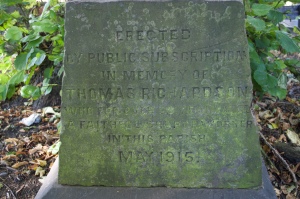
Thomas Richardson Plinth Holy Trinity Church Short Heath, Willenhall
On 24 November 1861, at nineteen years old, Thomas married Susannah Appleby at St Stephen's Church in Willenhall. He started to build himself something his childhood had stolen from him: a family. Together, Thomas and Susannah would have thirteen children, with three dying in infancy. Their fourth child, Fanny, was my great-grandmother, connecting me to this remarkable man.
Thomas settled in Short Heath, Willenhall, working as a locksmith and raising a family that may have helped somewhat in alleviating the pain he felt at being abandoned. My paternal aunt told me that he became a deacon of Holy Trinity Church on Coltham Road. The church has told me there are no records to confirm this; however, there is evidence within the church graveyard.
There is a stone plinth that once held a lamp, erected by public subscription. The inscription reads:
"ERECTED BY PUBLIC SUBSCRIPTION IN MEMORY OF THOMAS RICHARDSON WHO FOR OVER 30 YEARS WAS A FAITHFUL CHURCH WORKER IN THIS PARISH"
He was loved and respected enough that the church community raised the funds to commemorate the man he became.
What I Admire
I admire that Thomas continued to live a good life, working as a locksmith, raising a family, and dedicating his life to his church. He could easily have become resentful and had a life that spiralled. He was essentially an orphan with his father dead and his mother in another world. What contact he had with his family after they left is unknown, but in an era with no telephones or ease of travel, this separation was permanent. It is very likely that he never saw them again and possibly lost all contact with them due to the distance.
He could have become hardened with such a rough early start to life, but the limited evidence I have found tells a story of a dedicated family man, locksmith, and deacon.
As a mother, I think about Ann Richardson sailing away from her teenage son, and my heart breaks for them both. As their descendant, I look at Ann as being in an impossible position and Thomas as having built a life all on his own. He turned his abandonment into belonging.
Thomas died on 3 December 1914, at their home at 87 Coltham Road, Short Heath, of bronchitis and cardiac failure. He was seventy-two years old. He was buried in the Holy Trinity churchyard just metres up the road from their home. His beloved wife Susannah joined him on 3 April 1916. At this stage I do not know the exact location of their grave; however, I hope it is somewhere near the plinth, that to this day remembers his service to the church.
I have been to the church graveyard but did not find his grave at that time, but did see the plinth. I hope to be able to visit again soon and find him to say thanks. To thank him for his perseverance in adversity, for creating a family that eventually included me and my children, and finally for showing me that tragedy does not need to define me.
Thomas Richardson was the boy left behind and became a man that people celebrated. This is why he is an ancestor I admire.
Thomas Richardson (1842-1914) was my second great-grandfather on my paternal grandmother's side. If you are related to the Richardson or Appleby families of Willenhall, or the Rands family who emigrated to New York in 1857, I would love to hear from you.
Are you doing the 52 Ancestors in 52 Weeks Challenge?

 This is the story of my second great-grandfather, Thomas Richardson, a story that has saddened me since I uncovered it. Thomas was born in 1842 in Silsoe, Bedfordshire to Samuel Richardson and Ann Rands. Thomas was their firstborn child, followed by Charles (b.1844), Susannah (b.1845), Betsey (b.1847), and an unnamed boy (b.1849-d.1849). In 1851, Betsey, aged 4 years, died. The following year on 19 July 1852, Samuel was found deceased, with the coroner finding that he "was found drowned after becoming inebriated. He was of good character when sober but had taken to drinking regularly in recent weeks." In early 1853 their sixth child, Elizabeth, was born, with Ann probably discovering her pregnancy shortly after Samuel's death. Samuel's tragic death precipitated the events of the following years. Ann was left alone with four children aged from 0 to 10 years.
On 3 September 1857, Ann, Charles, Susannah, and Elizabeth departed from Liverpool aboard the ship Calhoun bound for New York. The poor union had paid to send them to America to reunite with Ann's parents, Robert and Elizabeth Rands, who lived in Ontario, Canada. This is what haunts me - Thomas, a boy of fifteen, is left behind on his own.
I am a mother, and when I discovered Thomas' story, my son was about fourteen years old. I tried to imagine what would make me leave one of my children behind and sail to the other side of the world. I tried to picture my young son left behind, and it broke my heart. However, poverty and the poor law unions of the Victorian era were ruthless with little regard for the preservation of the family unit. The cost of sending him with his family was probably considered unjustified given he was of working age which justified them finding him work rather than keeping the family unit intact.
Thomas was apprenticed to George Tuckley, a locksmith based in New Invention, Willenhall, Staffordshire, a village 90 miles north-west of his home in Silsoe.
I wonder how Ann felt at decisions that were more than likely not hers to make and she had no real choice in the whole situation.
Whatever the reasoning, fifteen-year-old Thomas was left behind. In the space of eight years the loss he experienced was more than any young boy should – a brother, sister, and father had died. Now his remaining three siblings and his mother had moved to live with his grandparents in another country, and he was living in a new county in the home of his boss.
This is the story of my second great-grandfather, Thomas Richardson, a story that has saddened me since I uncovered it. Thomas was born in 1842 in Silsoe, Bedfordshire to Samuel Richardson and Ann Rands. Thomas was their firstborn child, followed by Charles (b.1844), Susannah (b.1845), Betsey (b.1847), and an unnamed boy (b.1849-d.1849). In 1851, Betsey, aged 4 years, died. The following year on 19 July 1852, Samuel was found deceased, with the coroner finding that he "was found drowned after becoming inebriated. He was of good character when sober but had taken to drinking regularly in recent weeks." In early 1853 their sixth child, Elizabeth, was born, with Ann probably discovering her pregnancy shortly after Samuel's death. Samuel's tragic death precipitated the events of the following years. Ann was left alone with four children aged from 0 to 10 years.
On 3 September 1857, Ann, Charles, Susannah, and Elizabeth departed from Liverpool aboard the ship Calhoun bound for New York. The poor union had paid to send them to America to reunite with Ann's parents, Robert and Elizabeth Rands, who lived in Ontario, Canada. This is what haunts me - Thomas, a boy of fifteen, is left behind on his own.
I am a mother, and when I discovered Thomas' story, my son was about fourteen years old. I tried to imagine what would make me leave one of my children behind and sail to the other side of the world. I tried to picture my young son left behind, and it broke my heart. However, poverty and the poor law unions of the Victorian era were ruthless with little regard for the preservation of the family unit. The cost of sending him with his family was probably considered unjustified given he was of working age which justified them finding him work rather than keeping the family unit intact.
Thomas was apprenticed to George Tuckley, a locksmith based in New Invention, Willenhall, Staffordshire, a village 90 miles north-west of his home in Silsoe.
I wonder how Ann felt at decisions that were more than likely not hers to make and she had no real choice in the whole situation.
Whatever the reasoning, fifteen-year-old Thomas was left behind. In the space of eight years the loss he experienced was more than any young boy should – a brother, sister, and father had died. Now his remaining three siblings and his mother had moved to live with his grandparents in another country, and he was living in a new county in the home of his boss.
 I admire that Thomas continued to live a good life, working as a locksmith, raising a family, and dedicating his life to his church. He could easily have become resentful and had a life that spiralled. He was essentially an orphan with his father dead and his mother in another world. What contact he had with his family after they left is unknown, but in an era with no telephones or ease of travel, this separation was permanent. It is very likely that he never saw them again and possibly lost all contact with them due to the distance.
He could have become hardened with such a rough early start to life, but the limited evidence I have found tells a story of a dedicated family man, locksmith, and deacon.
As a mother, I think about Ann Richardson sailing away from her teenage son, and my heart breaks for them both. As their descendant, I look at Ann as being in an impossible position and Thomas as having built a life all on his own. He turned his abandonment into belonging.
Thomas died on 3 December 1914, at their home at 87 Coltham Road, Short Heath, of bronchitis and cardiac failure. He was seventy-two years old. He was buried in the Holy Trinity churchyard just metres up the road from their home. His beloved wife Susannah joined him on 3 April 1916. At this stage I do not know the exact location of their grave; however, I hope it is somewhere near the plinth, that to this day remembers his service to the church.
I have been to the church graveyard but did not find his grave at that time, but did see the plinth. I hope to be able to visit again soon and find him to say thanks. To thank him for his perseverance in adversity, for creating a family that eventually included me and my children, and finally for showing me that tragedy does not need to define me.
Thomas Richardson was the boy left behind and became a man that people celebrated. This is why he is an ancestor I admire.
I admire that Thomas continued to live a good life, working as a locksmith, raising a family, and dedicating his life to his church. He could easily have become resentful and had a life that spiralled. He was essentially an orphan with his father dead and his mother in another world. What contact he had with his family after they left is unknown, but in an era with no telephones or ease of travel, this separation was permanent. It is very likely that he never saw them again and possibly lost all contact with them due to the distance.
He could have become hardened with such a rough early start to life, but the limited evidence I have found tells a story of a dedicated family man, locksmith, and deacon.
As a mother, I think about Ann Richardson sailing away from her teenage son, and my heart breaks for them both. As their descendant, I look at Ann as being in an impossible position and Thomas as having built a life all on his own. He turned his abandonment into belonging.
Thomas died on 3 December 1914, at their home at 87 Coltham Road, Short Heath, of bronchitis and cardiac failure. He was seventy-two years old. He was buried in the Holy Trinity churchyard just metres up the road from their home. His beloved wife Susannah joined him on 3 April 1916. At this stage I do not know the exact location of their grave; however, I hope it is somewhere near the plinth, that to this day remembers his service to the church.
I have been to the church graveyard but did not find his grave at that time, but did see the plinth. I hope to be able to visit again soon and find him to say thanks. To thank him for his perseverance in adversity, for creating a family that eventually included me and my children, and finally for showing me that tragedy does not need to define me.
Thomas Richardson was the boy left behind and became a man that people celebrated. This is why he is an ancestor I admire.

Leave a Reply