Back in the 1990s when I started researching my family history, my Auntie Eileen told me a story about her maternal grandfather, Samuel Ernest Stokes. She remembered visiting her grandparents one day, and shortly after arriving home, they received urgent word to turn around as he had been in an accident. Samuel had been seriously injured.
For two decades, that is all I knew. A family story that was passed down to me. Family stories are sometimes fanciful but at times they can also be based in fact. I knew Samuel had died relatively young at 59 years in 1930, meaning my Auntie Eileen was just 3 years and 9 months old. How much of her memory could I rely upon?
In 2018, I obtained Samuel's death certificate. He died on 7 October 1930 in Walsall General Hospital. His cause of death was listed as "Shock due to fractured ribs and other injuries caused by accidently colliding with a Motor Lorry while riding a Motor Cycle in Bloxwich Road Walsall." The death certificate confirmed the family story; however, in December 2020, I found newspaper articles that added further context, depth, and colour to the story.
Grove Pit Disaster
The tragic death of Samuel was the culmination of an event that occurred at the Grove Pit on the 1st of October, just six days prior. The Grove Pit was a mine located in Brownhills, Staffordshire, when, on 1st October 1930, an explosion occurred at the mine, killing fourteen men. These mining disasters, while common at the time, still shook entire communities. These men were fathers, brothers, sons, and friends who were simply doing their job despite knowing the risks
Samuel Ernest Stokes was a coal miner himself, working as a stallman at the Mid-Cannock Colliery Company. In his testimony to the inquest into his father's death, Hector stated that Samuel had worked with one of the men killed in the explosion and considered them close friends.
On Tuesday morning, 7 October 1930, Samuel set out on his motorcycle for the funeral at Brownhills of ten of the miners, including his friend. He was going to pay his respects to men who had shared the same dangers as a miner.
He never made it.
11:35 a.m., Blakenall Lane
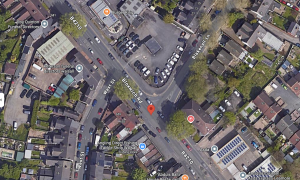
Intersection where the accident occurred.
The newspaper articles report the accident and the inquest, outlining how at 11:35 in the morning, at the intersection of Blakenall Lane and Bloxwich Road in Leamore, Samuel was riding his motorcycle towards Walsall "at a pretty fast rate", according to witness George Henry Wood. The reasons why he was travelling so fast are unknown.
Charles Robert Watkins, a motor lorry driver, said he put his arm out to indicate and sounded his horn of his intention to turn into Blakenall Lane. He felt something bump the back of his lorry and found the motorcyclist in the gutter.
George Henry Wood, a sixteen-year-old miner from the Grove Pit, witnessed the accident, stating he was standing near Blakenall Lane when he saw a motorcycle travelling towards Walsall at a fast pace.
Samuel made a statement to a police officer that he was driving towards Walsall and did not see the lorry driver put out his arm. His son Hector testified at the inquest that his father had keen eyesight but was slightly deaf. He had been riding a motorcycle for six or seven years without incident.
On this particular morning, something went wrong. Perhaps it was the deafness that meant he did not hear the horn. Perhaps it was grief as he drove to say goodbye to a friend. Perhaps it was simply a split-second lapse of attention. Whatever occurred it had tragic consequences.
The Injuries
The Walsall Observer reported the extent of his injuries: a broken collarbone, four broken ribs on the left side, and a compound fracture of the shoulder. He was immediately taken to Walsall General Hospital, where Dr. Forrest, the house surgeon, said they did what they could, but he died of shock shortly after arriving.
Samuel Ernest Stokes died that same evening, just hours after the accident. He never made it to the funeral. His funeral was held at Holy Trinity Anglican Church in Short Heath on 12 October 1930, the same church where he'd married Fanny Richardson thirty-three years earlier.
What the Records Revealed
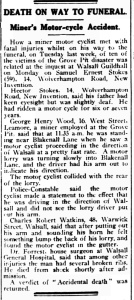
The article in The Mercury on 17 October 1930 discussing the accident and inquest.
These newspaper articles show that looking beyond the basic records of birth, marriage, and death, a deeper understanding of events can be found. The death certificate provided the facts: the date, the cause, and the location. However, the newspaper articles provided something far more valuable – they gave me the story.
I learned that Samuel wasn't just out for a ride; he was going to pay respects to ten men killed so tragically. I discovered the precise location and time of the accident, providing me with details that place him in a specific moment in time. I learned that there was a teenage witness named George Henry Wood who saw it happen, who carried that memory with him. I learned that Samuel's son Hector had to stand up at an inquest and answer questions about his father just days after Samuel's death.
I learned about the Grove Pit disaster, which I'd never heard of before, and the ripple effect that touched people beyond the families who lost men in the explosion. The newspapers revealed the interconnectedness of these mining communities – Samuel knew one of the victims; young George Henry Wood worked at the Grove Pit and witnessed Samuel's death. These men's lives were interconnected by their shared profession, its dangers, and the tragedy of Samuel's death.
The jury returned a verdict of accidental death. The coroner and the solicitor representing the lorry driver both expressed sympathy to the family. Life continued, but it had changed irrevocably from their life before. Samuel left behind his widow Fanny and their three children: my grandmother Dorcas, her husband Howard, their daughter Eileen, and Dorcas' brothers Oliver and Hector.
The Man Behind the Tragedy
Samuel was born in 1871 in Bloxwich to Henry Stokes and Harriet Allport. He started out as a bit maker and became a cycle engineer before heading down into the mines, working firstly as a roadman, then as a hewer, and finally as a stallman. He married Fanny Richardson, the daughter of Thomas Richardson and Susannah Appleby (you can read last week's post about them here) They had three children: Dorcas in 1898, Oliver in 1900, and Hector in 1905. Fanny died in 1951.
Why This Matters
I am grateful for these newspaper articles, as they transformed Auntie Eileen's childhood memory of a sudden, tragic accident into a story with context. A man died on his way to honour a friend who died in a mining disaster, a reminder of the inherent dangers of the occupation he worked in.
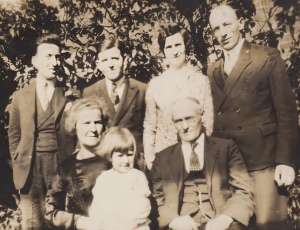
The Stokes family shortly before Samuel's death. Front row: Fanny Stokes (nee Richardson), Eileen Walker, Samuel Stokes. Back row: Hector Stokes, Howard Walker, Dorcas Stokes, Oliver Stokes.
Without these articles, Samuel's death would just provide the contents of his death certificate – date, place, and cause. He would have become just another person who died in an accident. These articles bring his story to life. He was a 59-year-old miner on a motorcycle, heading to pay his respects to a friend. He was slightly deaf, perhaps not hearing the lorry's horn, colliding with it, and being thrown into the gutter, dying hours later in a hospital bed, leaving behind a grieving wife and family.
These other records add colour to the lives of our ancestors. They transform genealogy from a collection of dates into a story of lives lived.
Have you found newspaper articles that told a story of your ancestor?
Head over to Find my Past today to find your ancestor's story.

 For two decades, that is all I knew. A family story that was passed down to me. Family stories are sometimes fanciful but at times they can also be based in fact. I knew Samuel had died relatively young at 59 years in 1930, meaning my Auntie Eileen was just 3 years and 9 months old. How much of her memory could I rely upon?
In 2018, I obtained Samuel's death certificate. He died on 7 October 1930 in Walsall General Hospital. His cause of death was listed as "Shock due to fractured ribs and other injuries caused by accidently colliding with a Motor Lorry while riding a Motor Cycle in Bloxwich Road Walsall." The death certificate confirmed the family story; however, in December 2020, I found newspaper articles that added further context, depth, and colour to the story.
For two decades, that is all I knew. A family story that was passed down to me. Family stories are sometimes fanciful but at times they can also be based in fact. I knew Samuel had died relatively young at 59 years in 1930, meaning my Auntie Eileen was just 3 years and 9 months old. How much of her memory could I rely upon?
In 2018, I obtained Samuel's death certificate. He died on 7 October 1930 in Walsall General Hospital. His cause of death was listed as "Shock due to fractured ribs and other injuries caused by accidently colliding with a Motor Lorry while riding a Motor Cycle in Bloxwich Road Walsall." The death certificate confirmed the family story; however, in December 2020, I found newspaper articles that added further context, depth, and colour to the story.
 Without these articles, Samuel's death would just provide the contents of his death certificate – date, place, and cause. He would have become just another person who died in an accident. These articles bring his story to life. He was a 59-year-old miner on a motorcycle, heading to pay his respects to a friend. He was slightly deaf, perhaps not hearing the lorry's horn, colliding with it, and being thrown into the gutter, dying hours later in a hospital bed, leaving behind a grieving wife and family.
These other records add colour to the lives of our ancestors. They transform genealogy from a collection of dates into a story of lives lived.
Without these articles, Samuel's death would just provide the contents of his death certificate – date, place, and cause. He would have become just another person who died in an accident. These articles bring his story to life. He was a 59-year-old miner on a motorcycle, heading to pay his respects to a friend. He was slightly deaf, perhaps not hearing the lorry's horn, colliding with it, and being thrown into the gutter, dying hours later in a hospital bed, leaving behind a grieving wife and family.
These other records add colour to the lives of our ancestors. They transform genealogy from a collection of dates into a story of lives lived.

Leave a Reply